
Every long-lived system eventually reaches a point where persistence is no longer enough.
It must answer a harder question:
Why is the thing that exists now legitimately continuous with the thing that existed before?
Computing has many partial answers.
We preserve data. Record history. Checkpoint processes. Version software. Authenticate identities. Assign permissions. Maintain audit logs. Recover failed systems. Give AI agents memory.
All of these mechanisms matter.
None of them, on its own, establishes continuity.
A database can persist while the meaning of its contents changes. An identity can remain stable while its authority changes. A system can remember a decision that no longer governs. An agent can recover its history while losing the purpose that gave that history meaning. A process can resume successfully from exactly the wrong state.
Persistence is not continuity.
Memory is not continuity.
Identity is not continuity.
Continuity concerns the legitimate relationship between what exists now and what existed before.
That relationship can be represented, evaluated, governed and proved.
Continuity can therefore be treated as a system.
1. The Continuity Problem
Consider an entity at two moments:
Xₜ
and
Xₜ₊₁
It is easy to establish that both exist.
The harder question is whether Xₜ₊₁ is a legitimate continuation of Xₜ.
What changed?
What was preserved?
What authorised the change?
Which prior state governed the transition?
Which invariants had to survive it?
Did the purpose remain intact?
What effects occurred?
What evidence makes the resulting state trustworthy?
Without answers to those questions, continuity is not established.
It is assumed.
That assumption becomes increasingly dangerous as systems become persistent, distributed, adaptive and capable of modifying both themselves and the environments in which they operate.
The more a system acts across time, the less acceptable it becomes to treat continuity as an accidental by-product of storage.
A long-running system cannot merely exist from one moment to the next.
It must be able to explain its succession.
2. Continuity as a System
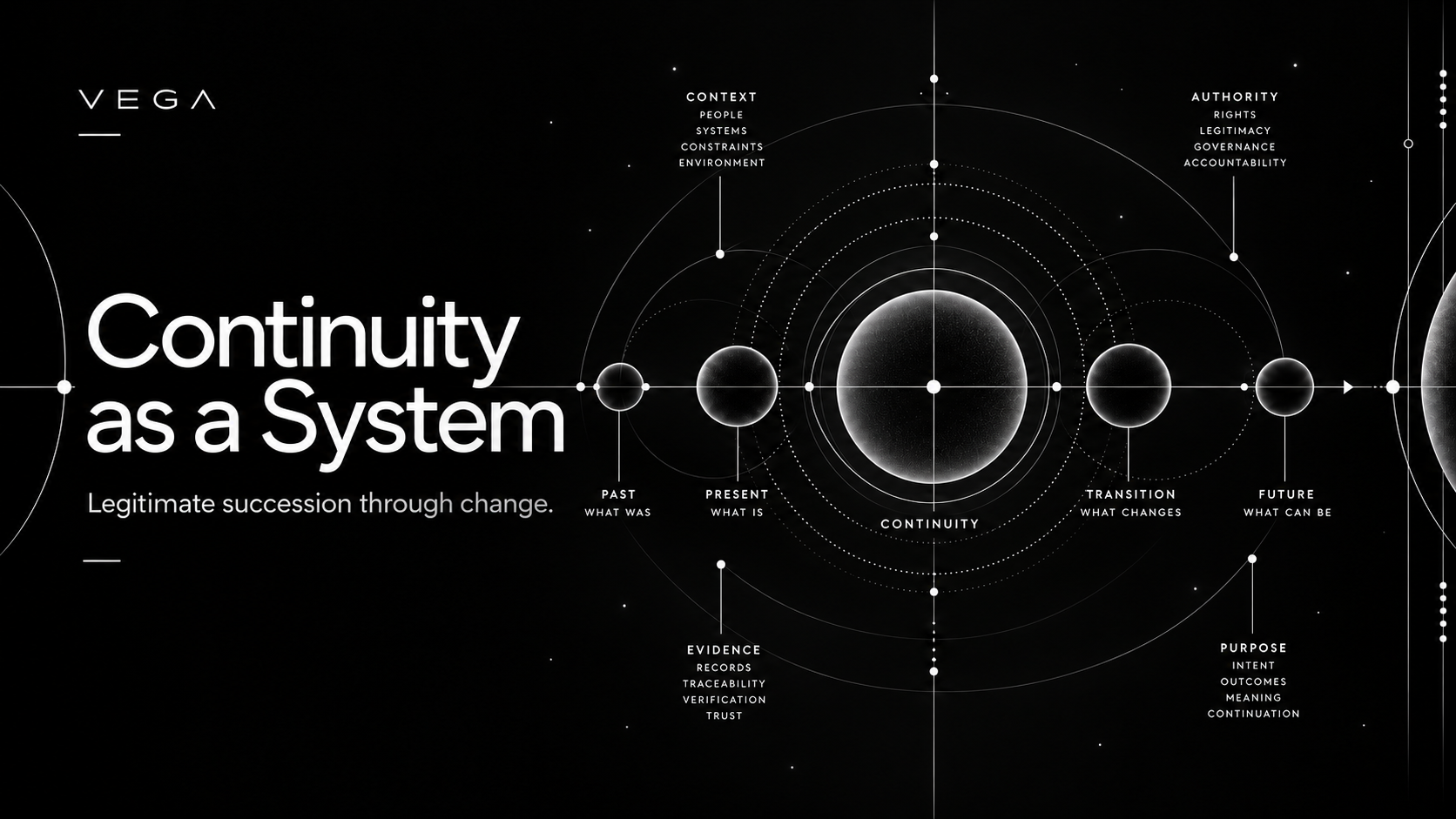
A Continuity System governs legitimate succession through change.
It does not merely preserve what existed before.
It determines what may change, what must remain, what authority governs the change, what effects occurred, what evidence supports those effects, and whether the resulting state may legitimately succeed the one before it.
This requires several distinct but connected elements:
Identity — what the entity is
State — what is currently true of it
Authority — what may govern or change it
Intent — what purpose the system is meant to preserve
Lineage — how the present state came to exist
Invariants — what must remain true through change
Transition — what changes between accepted states
Effects — what actually happens as a result
Evidence — what supports claims about those effects
Acceptance — what determines whether the successor may govern
These are not separate administrative concerns.
Together, they form the continuity relationship.
And the central object in that relationship is not memory.
It is not even state.
It is the transition between accepted states.
3. Legitimate Succession
The core proposition of this work is:
Continuity is legitimate succession across change.
That definition matters because continuity does not mean sameness.
A system that cannot change is not strongly continuous. It is simply static.
A continuous system may learn, revise itself, replace components, migrate environments, correct false beliefs, change operators, supersede decisions and abandon obsolete structures.
The requirement is not immobility.
The requirement is that change remains connected to what preceded it through an intelligible and legitimate chain.
Continuity therefore depends on both preservation and transformation.
Something must remain.
Something may change.
The system must know the difference.
4. The Continuity Model
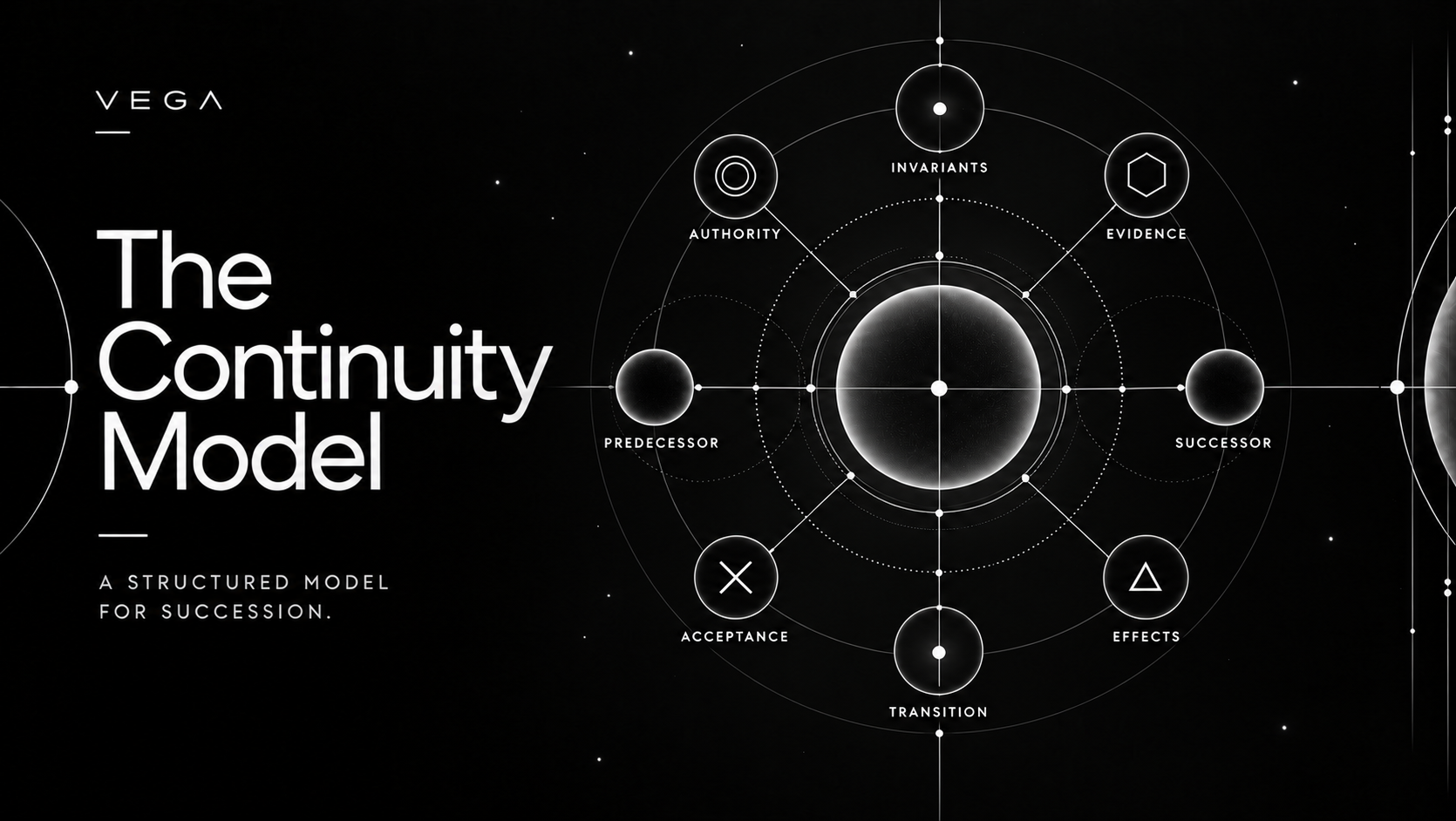
The minimum model consists of eight elements:
P = predecessor
A = authority
I = invariants
T = transition
F = effects
E = evidence
C = acceptance
S = successor
Together:
K = {P, A, I, T, F, E, C, S}
The continuity claim is not merely:
P → S
It is:
This successor is a valid continuation of this predecessor because an authorised transition occurred, the required invariants were preserved, the resulting effects were observed, sufficient evidence supports those effects, and the successor was explicitly accepted.
A successor does not become authoritative simply because it exists.
It becomes authoritative because it has been accepted through a valid continuity transition.
Continuity is therefore not a pile of versions.
It is a chain of accepted succession.
5. Predecessor
The predecessor is the accepted state from which a proposed transition begins.
It is not merely an earlier state.
It is the state currently recognised as governing within the relevant scope.
Without it, the system cannot reliably determine what changed, what was preserved, what was superseded, what authority applied, or whether the successor remains continuous.
A proposed successor without a valid predecessor is an orphan state.
Every continuity chain therefore begins either with a valid predecessor or with an explicit genesis state.
6. Authority
Authority answers:
What grants this actor or process the right to perform this change within this scope?
Authority may come from a person, governing document, policy, role, capability, institution, protocol or delegated mandate.
Authority must be identifiable, current, scoped, sufficient and unsuperseded.
Capability is not authority.
Access is not authority.
Execution is not authority.
The fact that a system can perform an action does not mean it may.
A transition performed outside valid authority creates an authority break, even if the resulting state is otherwise coherent.
7. Invariants
Invariants define what must remain true for continuity to survive change.
They answer:
What is not permitted to break?
An invariant may concern identity, ownership, safety, lineage, authority, purpose, structure, semantics, protocol, contractual obligation, or system boundary.
Without invariants, any successor could claim continuity with any predecessor.
A system could replace its identity, purpose, authority, structure and governing rules while still calling itself continuous merely because a database survived.
That is persistence masquerading as continuity.
8. Transition and Effects
The transition describes what was intended to change.
The effects describe what actually changed.
These must remain separate.
An authorised transition may fail. It may partially succeed. It may produce unintended effects. It may report success while the external world remains unchanged.
Therefore:
requested ≠ executed
executed ≠ succeeded
succeeded ≠ proved
A continuity system must distinguish intention from outcome.
9. Evidence
Evidence supports claims about what actually happened.
It answers:
Why should the system believe this transition occurred as claimed?
Evidence may include logs, state snapshots, external observations, cryptographic digests, signatures, test results, receipts, source history, user confirmations, database records, or reproducible verification.
Evidence must be matched to the claim it supports.
A command log proves that a command was issued. It does not prove the intended external effect occurred.
A hash proves integrity of content. It does not prove that the content was authorised.
A human approval proves acceptance. It does not prove technical correctness.
10. Acceptance
Acceptance determines whether a candidate successor becomes governing state.
Existence does not imply acceptance.
Completion does not imply acceptance.
Persistence does not imply acceptance.
Only an accepted successor should become the governing predecessor for subsequent transitions.
Continuity depends on explicit succession, not accidental survival.
11. Continuity Failure
Once continuity is represented explicitly, continuity failures become classifiable.
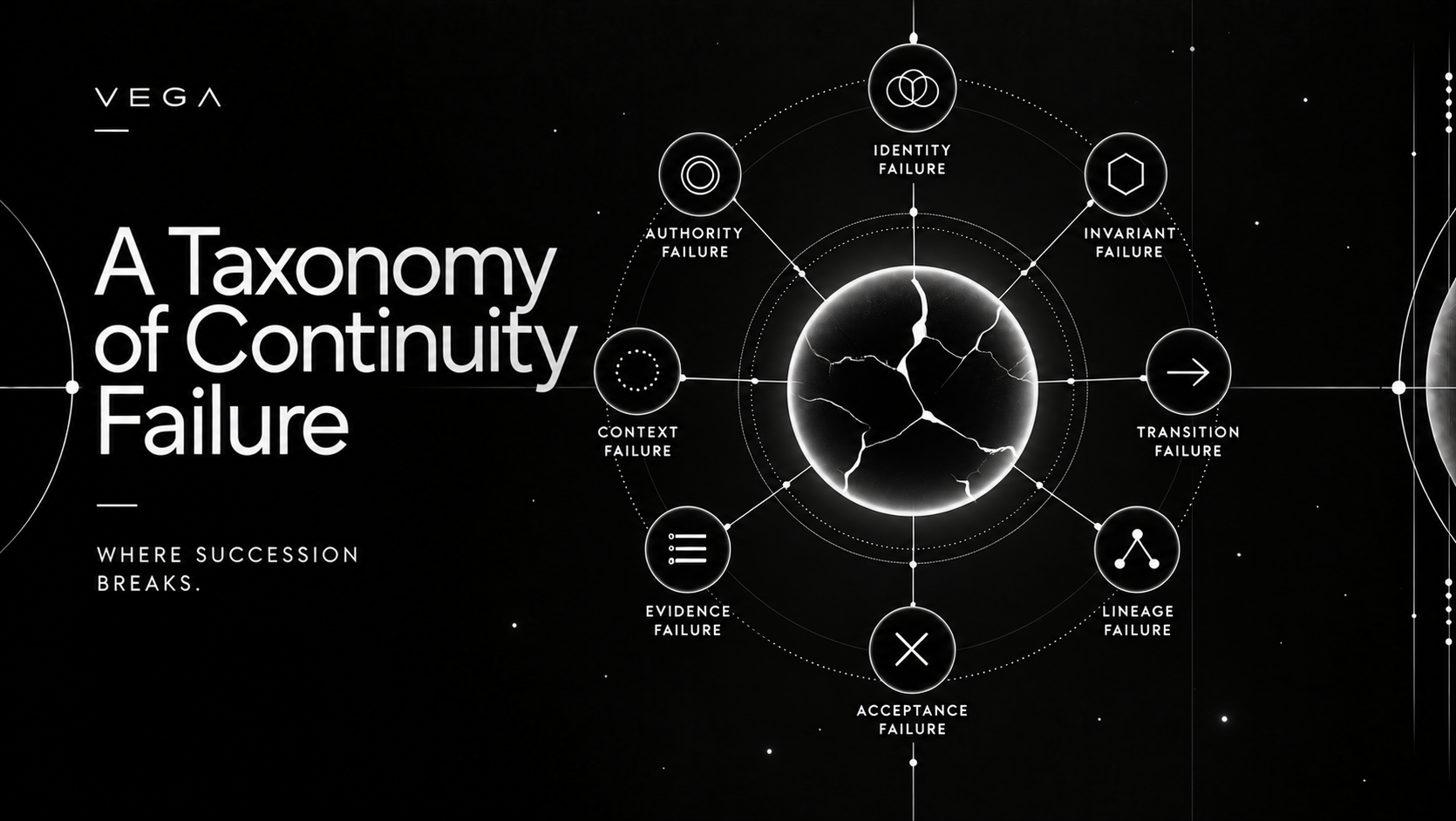
A useful initial taxonomy contains eight failure modes:
Orphan State — a state exists without a valid predecessor relationship.
Authority Break — a transition occurs without sufficient current authority.
Identity Break — a successor violates the invariants required to remain the same entity.
Lineage Break — the system cannot reconstruct the accepted chain that produced the current state.
Intent Drift — the system remains locally coherent while departing from governing purpose.
Conflicting Succession — incompatible successors claim authority from the same predecessor in the same exclusive scope.
Unproven Transition — a transition is claimed to have succeeded without sufficient evidence.
Stale Authority — once-valid authority continues to govern after supersession, revocation or expiry.
The diagnostic question becomes:
Where did legitimate succession break?
12. Continuity Protocol
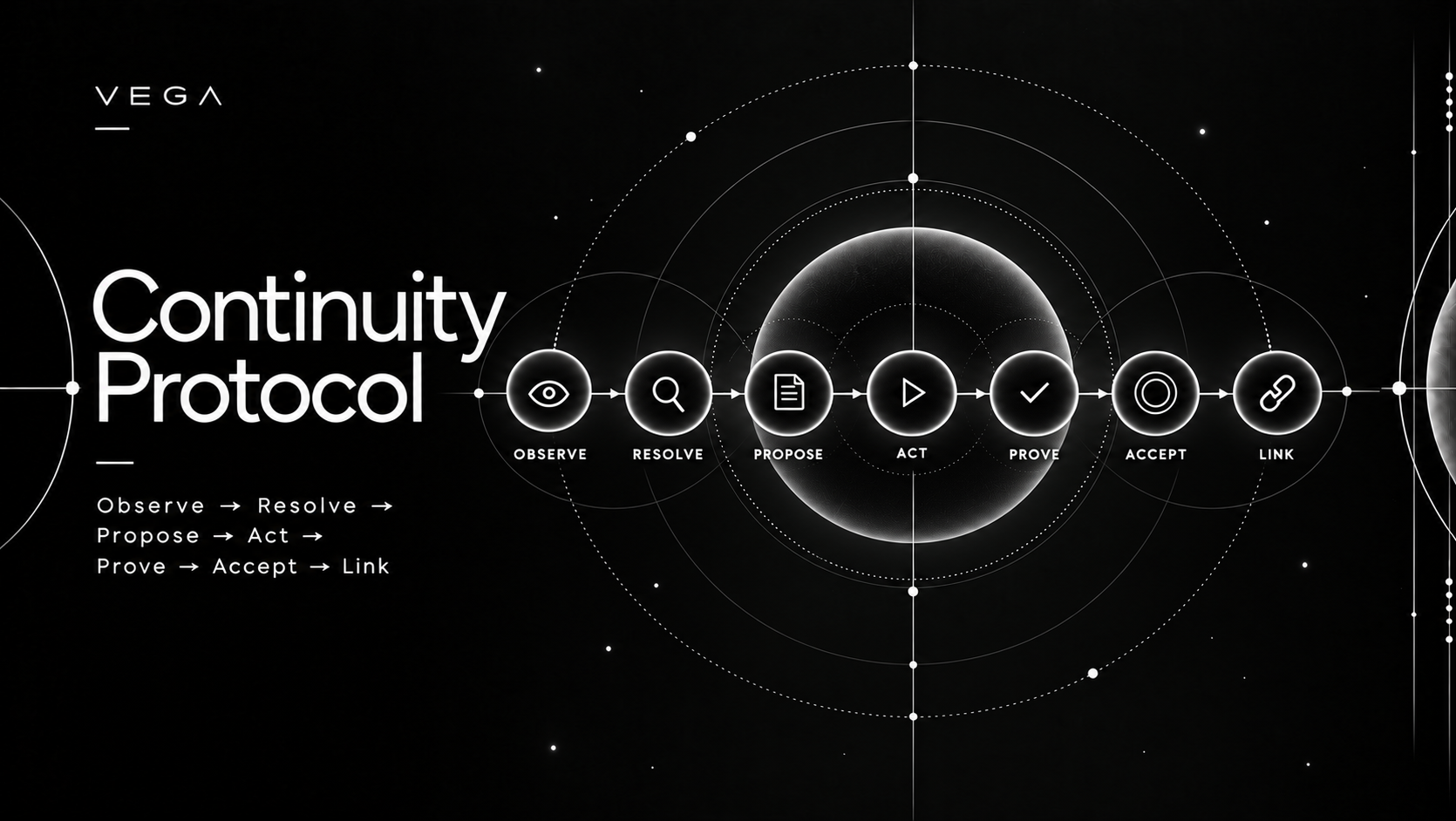
The model becomes operational through a simple protocol:
Observe → Resolve → Propose → Act → Prove → Accept → Link
Observe — what is true before anything changes?
Resolve — what governs this change?
Propose — what is intended to change?
Act — what was actually done?
Prove — what actually happened?
Accept — may the resulting state govern?
Link — how does the successor inherit from the predecessor?
Observe what is. Resolve what governs. Propose what changes. Act within authority. Prove what happened. Accept what may govern. Link what follows.
13. The Continuity Gate
A successor should pass through a continuity gate before promotion into governing state.
The gate asks:
- valid predecessor?
- valid authority?
- applicable invariants?
- observed effects?
- sufficient evidence?
- explicit acceptance?
The gate need not prevent experimentation or provisional work.
It governs promotion into accepted state.
14. Continuity Outcomes
A transition should terminate in an explicit outcome:
Valid — the successor is accepted and continuity is established.
Invalid — a continuity requirement has failed.
Unresolved — the system lacks enough information to establish continuity.
Provisional — the successor may operate under bounded conditions but has not achieved full acceptance.
Uncertainty should remain visible.
Sometimes the correct answer is simply:
continuity unresolved
15. Repair
Repair is itself a continuity transition.
A system must not repair continuity by bypassing continuity.
Repair therefore follows the same protocol:
observe failure → resolve authority → propose repair → act → prove → accept → link
A new genesis is not a normal repair.
It is reconstitution.
16. Continuity Receipt
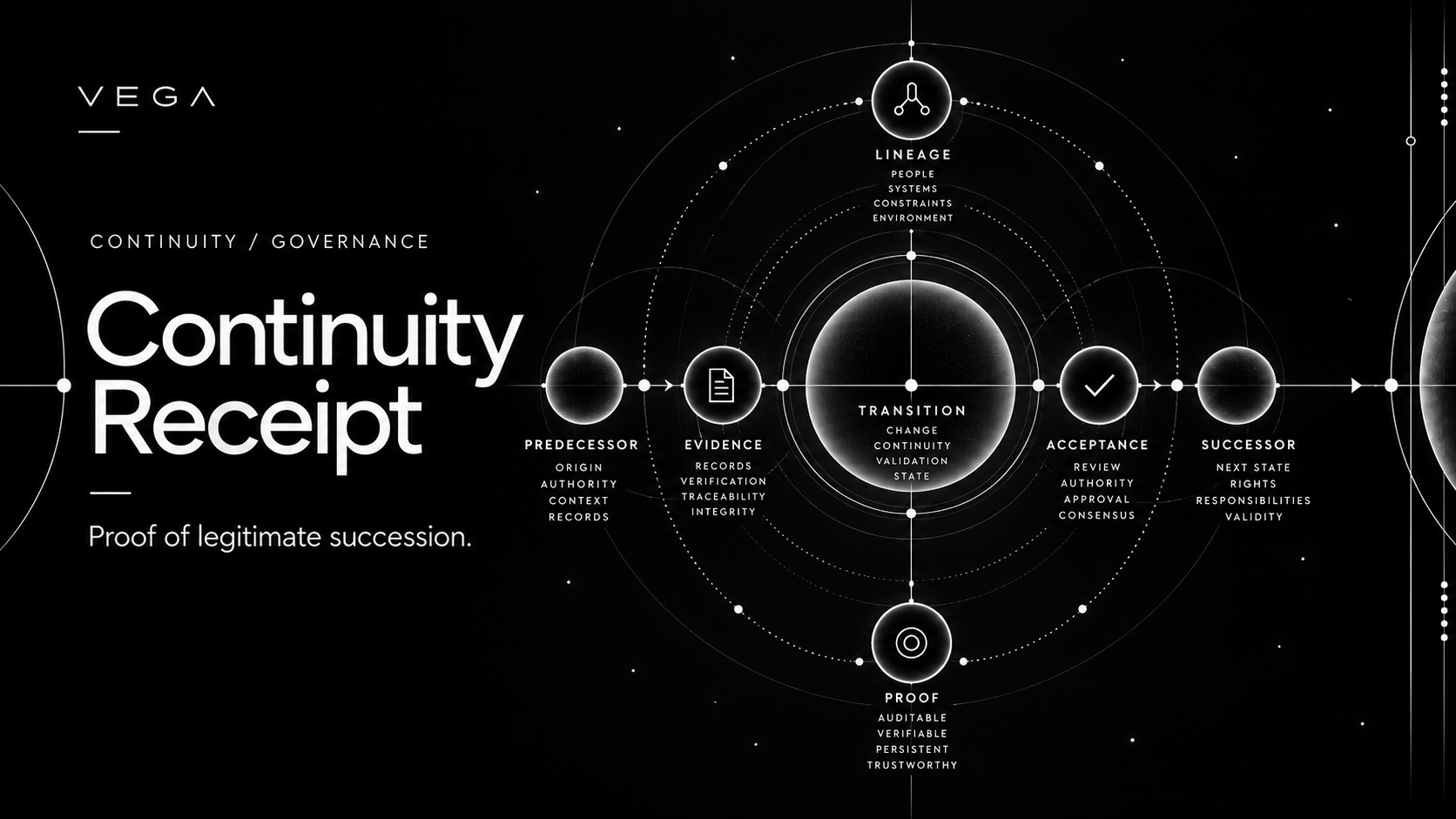
Every accepted transition should be capable of producing a Continuity Receipt.
The receipt is the portable proof object for legitimate succession.
It answers:
Why is this successor entitled to govern after this predecessor?
A receipt should identify predecessor, successor, transition, authority, invariants, effects, evidence, acceptance and continuity status.
The receipt does not create legitimacy.
It records the grounds on which legitimacy was established.
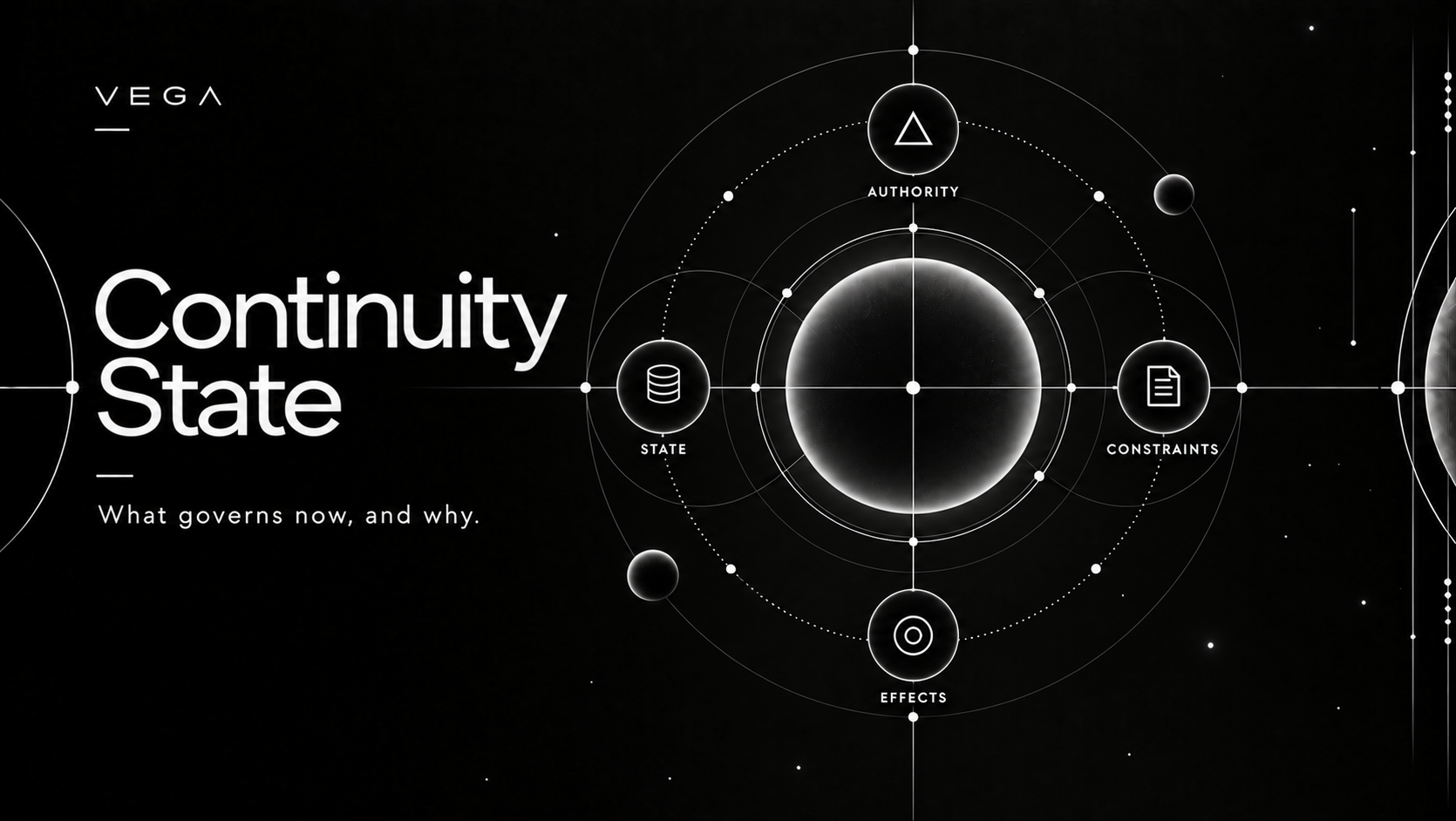
17. Continuity State
The receipt explains the past transition.
A continuity-aware system also needs to expose its live continuity state.
System state answers:
What is true now?
Continuity state answers:
Why is this the governing truth now, and under what conditions may it change?
A minimal continuity state includes identity, scope, current accepted state, predecessor, governing receipt, current authority, active invariants, governing intent, last accepted transition, evidence status, acceptance status, lineage status, conflicts, failures, constraints, permitted next actions and overall continuity status.
This turns continuity from retrospective history into an active control surface.
18. Continuity State Must Be Derived
Continuity state should be derived from authoritative continuity records.
It should not become another manually maintained source of truth.
Conceptually:
accepted states + continuity receipts + current authority + active invariants + failure/conflict state → continuity state
A derived operational view should not quietly become a competing authority.
19. Constraints Must Follow Status
Continuity status should have operational consequences.
If authority is unresolved, some actions should be blocked.
If lineage is broken, destructive changes may need to stop.
If a successor is provisional, its permitted scope should remain bounded.
If conflicting succession exists, promotion may require escalation.
Diagnosis without consequence is decorative observability.
20. Scope
Continuity is always scoped.
A system may be continuous in one dimension and discontinuous in another.
A software migration may preserve behaviour while breaking lineage.
A leadership change may preserve institutional identity while replacing authority.
A model update may preserve service identity while replacing internal implementation.
Continuity claims must say what is continuous with what, and in what respect.
21. Genesis
Every continuity chain requires an origin.
The first accepted state is the genesis state.
Genesis cannot derive legitimacy from a predecessor because none exists.
Its legitimacy must come from an explicit act of constitution, creation or recognition.
Once genesis is established, later states proceed through succession rather than repeated re-foundation.
22. Supersession
Continuity does not require previous states to disappear.
It requires their status to remain clear.
A predecessor may remain historically valid after supersession.
It simply ceases to govern within the affected scope.
historically valid ≠ currently authoritative
Continuity preserves history without confusing history with authority.
23. Forks and Conflicting Succession
Branching does not necessarily break continuity.
Conflict arises when incompatible successors claim exclusive authority over the same scope.
A continuity-aware system must distinguish branch, fork, candidate, accepted successor, governing successor and conflict.
Time is not authority.
24. Continuity and Intent
Perfect state integrity is not sufficient.
A system can remain authorised, traceable, well evidenced and internally consistent while still drifting away from the purpose it was meant to preserve.
A system should therefore periodically ask:
Does the current trajectory still serve the governing purpose that legitimised this chain of change?
Intent should not mutate accidentally through accumulated convenience.
25. Continuity and Identity
Identity is similarly dynamic.
Continuity does not require perfect sameness.
It requires that the invariants defining identity survive, or that their modification be explicitly authorised.
A system should distinguish transformed but continuous, forked, replaced, reconstituted and new.
Labels are weak continuity evidence.
26. Continuity and AI
AI makes continuity unusually visible because AI systems are beginning to operate across time.
Once a system remembers, acts, delegates, modifies external state, develops durable relationships, acquires authority, resumes work, updates itself, and coordinates with other systems, continuity stops being a convenience.
It becomes infrastructure.
Memory alone cannot solve this.
A memory system may remember an old decision perfectly while failing to recognise that the decision was superseded.
A context window may contain all relevant history while still failing to resolve which source governs now.
An agent may preserve identity language while violating the invariants that made the identity meaningful.
An autonomous system may execute a transition perfectly while operating outside legitimate authority.
These are continuity problems.
Not memory problems.
27. Beyond AI
The same model applies far beyond agents.
A Continuity System can govern software, organisations, institutions, knowledge systems, publications, digital identities, governance frameworks, long-running projects, public infrastructure, constitutional structures, and scientific bodies of knowledge.
Any entity expected to remain meaningfully itself while changing has a continuity problem.
There is always some version of:
what existed → what governed → what changed → what had to remain → what happened → what proves it → what was accepted → what now succeeds
That is the continuity relationship.
28. The Missing Layer
Most systems can answer:
What is true now?
Very few can reliably answer:
Why is what is true now legitimately connected to what came before?
Today, that relationship is often reconstructed manually from logs, source history, meeting notes, memory stores, database records, policy documents, version histories, operator recollection and institutional folklore.
The evidence may exist.
The continuity relationship itself is rarely first-class.
It should be.
29. What a Continuity-Aware System Should Know
At any given moment, a mature system should be able to answer:
Who am I?
What scope is being evaluated?
What state currently governs?
What was its predecessor?
What receipt established succession?
What authority currently governs?
Is that authority still current?
What invariants must survive?
What governing intent applies?
What transition produced the current state?
What effects were observed?
What evidence supports those effects?
Was the successor explicitly accepted?
Is lineage intact?
Are there competing successors?
Are there active continuity failures?
What actions are constrained?
What may legitimately happen next?
If those questions cannot be answered, continuity may still exist in practice.
But it is not yet established as a system property.
30. Protocol Invariants
A continuity system should itself obey several rules.
No silent promotion
A candidate successor must not become governing merely because it exists.
No silent authority
Capability, access or execution must not be treated as authority.
No silent success
Attempted action must not become assumed effect.
No silent supersession
Historical state must not gain or lose authority invisibly.
No silent certainty
Unknown continuity conditions must remain unresolved.
No silent identity replacement
A successor that violates defining invariants must not quietly inherit the identity of its predecessor.
No correction by overwrite
Continuity history should be repaired through explicit succession, not silent mutation.
31. The Continuity Rule
The framework can be reduced to one rule:
No successor becomes governing state unless its succession from the accepted predecessor can be justified through authority, invariants, effects, evidence and acceptance.
State cannot silently become authority.
Memory cannot silently become truth.
Execution cannot silently become success.
History cannot silently become governance.
Access cannot silently become permission.
A proposal cannot silently become a decision.
A candidate cannot silently become the system.
Every governing state must earn its place in the continuity chain.
32. The Larger Shift
The traditional question is:
Can the system continue running?
Continuity asks something harder:
Can the system continue being legitimately itself?
That question contains more than uptime.
It contains identity, authority, lineage, intent, change, proof and succession.
A system that survives technically while losing those relationships may still be operational.
But its continuity may already have broken.
33. Continuity as Infrastructure
As systems become more adaptive, distributed and autonomous, individual operations matter less in isolation.
What matters increasingly is whether those operations belong to an intelligible whole.
Can the system explain where it came from?
Can it identify what governs now?
Can it distinguish current authority from historical authority?
Can it prove what changed?
Can it detect where succession broke?
Can it constrain itself when continuity becomes unresolved?
Can it repair the chain without fabricating history?
Can it show why the thing that exists now is entitled to follow from the thing that existed before?
That is not a logging problem.
It is not merely a memory problem.
It is not merely a provenance problem.
It is not merely a governance problem.
Those are parts of a larger system.
The system is continuity.
34. Conclusion
Continuity is usually treated as something systems either happen to preserve or fail to preserve.
That is too weak.
Continuity can be made explicit.
It can be modelled.
It can be constrained.
It can be tested.
It can fail in identifiable ways.
It can be repaired.
It can produce proof.
It can expose its current state.
It can govern what happens next.
Once continuity is treated this way, the relationship between past and present stops being an assumption.
It becomes a system.
And the defining question becomes unavoidable:
Why is this successor entitled to follow from what came before?
A system that can answer that question has more than memory.
More than history.
More than persistence.
It has continuity.
Continuity is legitimate succession across change.
Sean Manouge
22 September 2026