
1. Purpose
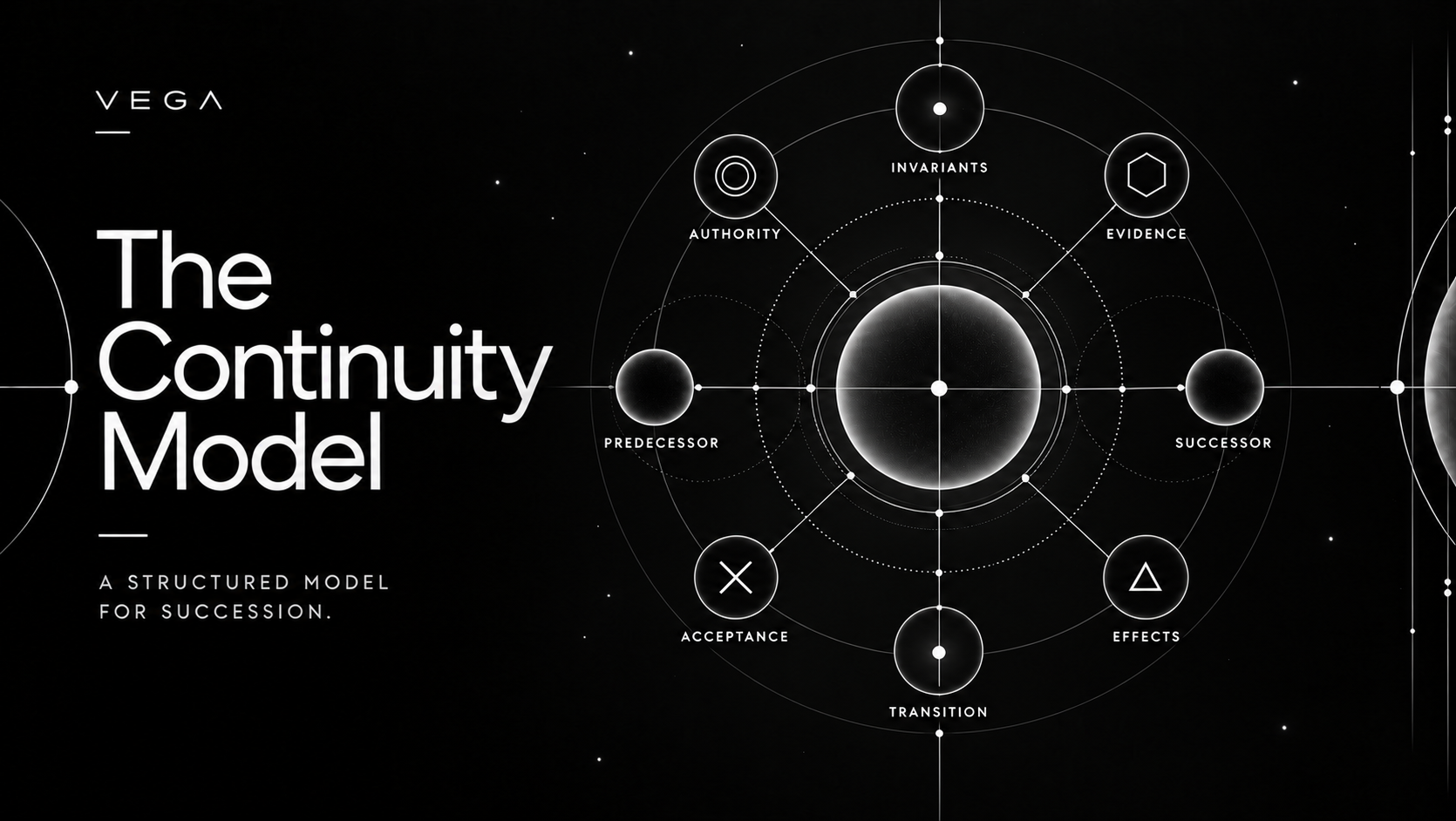
The Continuity Model defines the minimum structure required to determine whether one state is a legitimate continuation of another.
Its purpose is not to preserve everything.
Its purpose is to establish whether change occurred without breaking the legitimate relationship between predecessor and successor.
The model treats continuity as a governed transition between accepted states.
At its simplest:
predecessor → transition → successor
But a transition is not valid merely because a successor exists.
For continuity to hold, the transition must also be authorised, preserve required invariants, produce intelligible effects, be supported by evidence, and result in an accepted successor state.
The full model is therefore:
predecessor + authority + invariants + transition + effects + evidence → acceptance → successor
This is the minimum continuity chain.
2. Core proposition
The model begins from one claim:
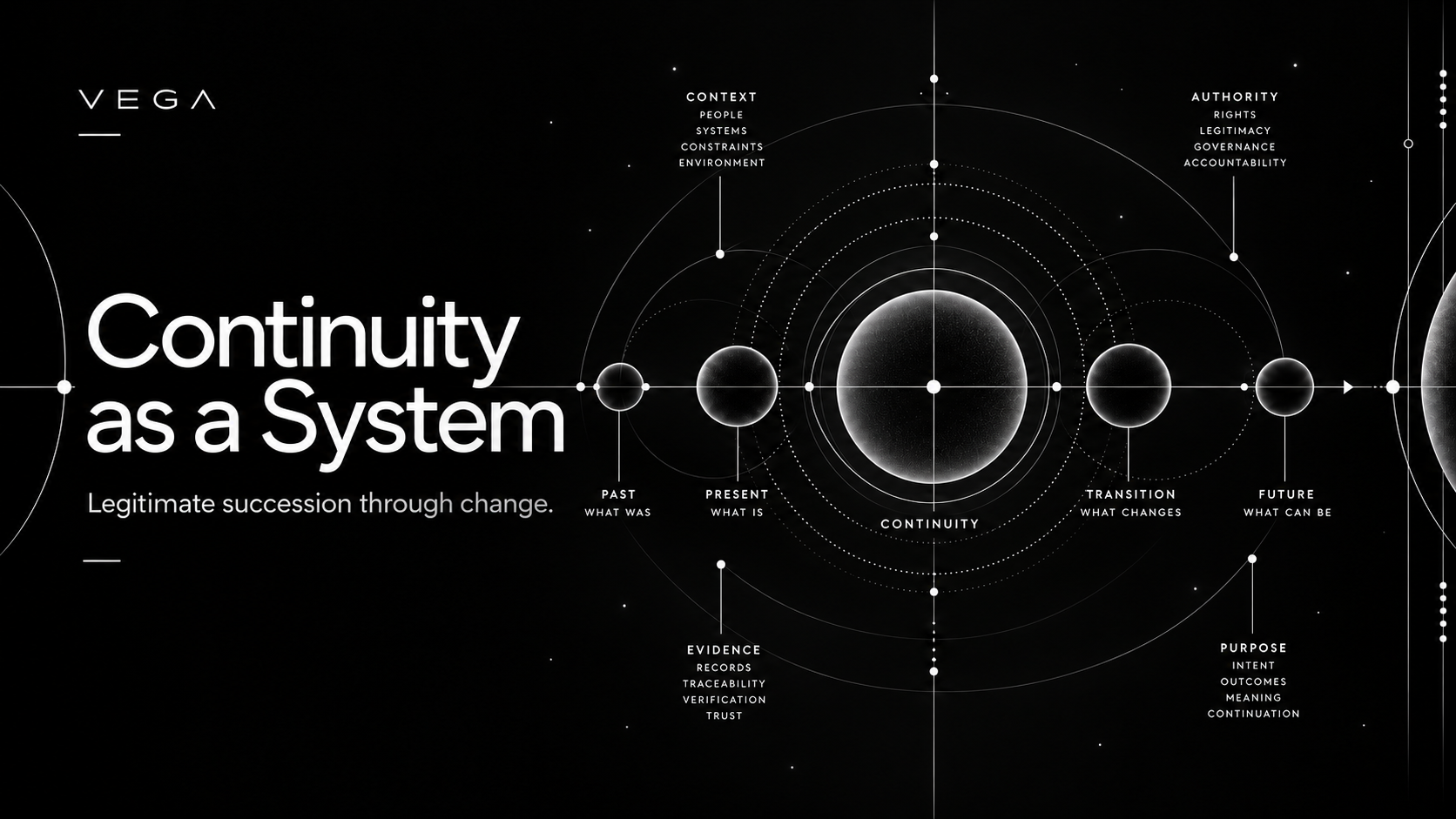
Continuity is legitimate succession across change.
A successor is continuous with its predecessor only when the relationship between them can be established.
That relationship must answer:
- what state existed before
- what was allowed to change
- what was required to remain true
- who or what authorised the change
- what transition occurred
- what effects the transition produced
- what evidence supports those effects
- whether the resulting state was accepted
A system that cannot answer these questions may still preserve data, history or identity.
It has not yet established continuity.
3. The continuity unit
The fundamental unit of the model is the continuity transition.
Let:
P = predecessor state
S = successor state
A = authority
I = invariants
T = transition
F = effects
E = evidence
C = acceptance
A continuity transition may be represented as:
K = {P, A, I, T, F, E, C, S}
Continuity holds only when the resulting successor can be legitimately derived from the predecessor through that complete relationship.
In conceptual form:
P ──T──▶ S
subject to:
A authorising T
I constraining T
F describing what T actually changed
E supporting the claim that F occurred
C determining whether S becomes accepted state
The important distinction is that the successor does not become authoritative simply because it exists.
It becomes authoritative because it has been accepted through a valid continuity transition.
4. Predecessor
The predecessor is the accepted state from which a proposed transition begins.
It is not merely an earlier state.
It is the state currently recognised as governing the continuity chain within the relevant scope.
A predecessor must therefore be identifiable and authoritative.
Minimum properties:
predecessor:
  id
  scope
  accepted_at
  authority_status
  state_reference
The predecessor provides the baseline against which change is evaluated.
Without a predecessor, the system cannot determine what has been preserved, altered, superseded or violated.
A proposed successor without a valid predecessor is an orphan state.
Not every system requires a predecessor at origin. A newly created continuity chain may begin with a designated genesis state.
After genesis, succession should be explicit.
5. Authority
Authority determines whether the proposed transition is permitted to occur.
Authority answers:
What grants this actor or process the right to change this state within this scope?
Authority may originate from a person, governing document, protocol, role, delegated capability, machine policy or other recognised source.
Its form is less important than its explicitness.
Minimum properties:
authority:
  source
  actor
  scope
  permissions
  constraints
  validity
Authority must be evaluated relative to the transition.
An actor may possess authority in one scope and none in another.
An administrator may restart a service without possessing authority to redefine its institutional purpose.
An AI agent may update working state without possessing authority to alter its own governing identity.
A user may authorise a temporary action without superseding a permanent policy.
Authority is therefore always scoped.
A transition performed outside valid authority produces an authority break, even if its resulting state is otherwise coherent.
6. Invariants
Invariants define what must remain true for continuity to survive the transition.
They answer:
What is not permitted to break, even though change is occurring?
An invariant may concern:
- identity
- safety
- authority
- purpose
- ownership
- protocol
- structure
- semantics
- contractual obligations
- system boundaries
Minimum representation:
invariant:
  id
  scope
  condition
  severity
  authority_source
Invariants distinguish continuity from mere transformation.
Without invariants, any successor could claim continuity with any predecessor.
A company could replace its purpose, ownership, legal entity, governance, assets and name while still claiming uninterrupted identity merely because someone retained the same database.
That is persistence theatre.
Continuity requires explicit criteria for what must survive.
Not all invariants are permanent.
They may themselves be changed, but changing an invariant requires sufficient authority and must occur through its own legitimate transition.
7. Transition
The transition is the proposed change between predecessor and successor.
It is the active element of the model.
The transition describes what was intended to happen.
Minimum properties:
transition:
  id
  predecessor
  actor
  intent
  scope
  operations
  timestamp
A transition may:
- add state
- remove state
- modify state
- supersede authority
- migrate representation
- alter implementation
- delegate responsibility
- revoke capability
- correct an error
- accept a new governing decision
The transition should describe the change at the level required to evaluate continuity.
It need not record every CPU instruction or keystroke.
It must record enough to determine whether the successor legitimately follows from the predecessor.
This introduces an important distinction:
transition intent describes what was meant to change.
effects describe what actually changed.
The two are not assumed to be identical.
8. Effects
Effects are the observable consequences of the transition.
They answer:
What changed in reality?
This is necessary because authorised intent does not guarantee successful execution.
A transition may be validly authorised and correctly specified yet fail partially, produce unintended consequences, or have no effect at all.
Minimum properties:
effects:
  expected
  observed
  deviations
  external_changes
Effects may include changes to:
- system state
- external systems
- permissions
- files
- records
- identities
- relationships
- processes
- public outputs
- governing sources
The model separates transition from effects deliberately.
Otherwise, a system risks treating instructions as outcomes.
That is an especially dangerous mistake in autonomous systems.
“Requested” is not “occurred.”
“Executed” is not necessarily “succeeded.”
Continuity concerns the world after the transition, not merely the command that initiated it.
9. Evidence
Evidence supports claims about the transition and its effects.
It answers:
Why should the system believe this transition occurred as claimed?
Evidence may include:
- state snapshots
- cryptographic hashes
- logs
- test results
- signatures
- receipts
- user confirmations
- external observations
- database records
- source history
- attestations
- reproducible verification
Minimum properties:
evidence:
  claim
  source
  method
  timestamp
  integrity
Evidence quality depends on the claim being established.
A file hash can prove that a file matches a known state.
It cannot prove that the file's contents were authorised.
A log can prove that a process reported success.
It may not prove that the intended external effect occurred.
A human approval can establish acceptance.
It does not necessarily establish technical correctness.
Evidence must therefore be evaluated against the specific claim it supports.
Continuity is strongest when evidence is both relevant and independently verifiable.
10. Acceptance
Acceptance is the decision that promotes a candidate successor into accepted state.
It answers:
Does this successor now govern?
This is one of the most important elements of the model.
Existence does not imply acceptance.
Completion does not imply acceptance.
Persistence does not imply acceptance.
A transition may produce a technically valid candidate state that remains unaccepted because:
- evidence is incomplete
- required review has not occurred
- an invariant was violated
- authority was insufficient
- the transition produced unexpected effects
- another successor has priority
- the change remains provisional
Minimum properties:
acceptance:
  status
  authority
  scope
  accepted_at
  conditions
Possible acceptance states might include:
proposed
validated
accepted
rejected
superseded
revoked
Only an accepted successor becomes the governing predecessor for the next continuity transition.
This creates an explicit chain:
S₀
 ↓
T₁
 ↓
S₁ accepted
 ↓
T₂
 ↓
S₂ accepted
 ↓
T₃
 ↓
S₃ accepted
Continuity is therefore not a pile of versions.
It is a chain of accepted succession.
11. Successor
The successor is the resulting candidate state produced by the transition.
Once accepted, it becomes the current authoritative state within its scope.
Minimum properties:
successor:
  id
  predecessor
  transition
  state_reference
  continuity_status
A successor must preserve every invariant applicable to the transition unless those invariants were themselves legitimately modified.
The successor should also retain sufficient lineage to identify:
- its predecessor
- the transition that produced it
- the authority behind that transition
- the evidence supporting it
- the acceptance decision that promoted it
The successor therefore carries not only state.
It carries a continuity claim.
12. Continuity validity
A continuity transition is valid only if all required conditions hold.
In compact form:
Valid(K) = P ∧ A ∧ I ∧ T ∧ F ∧ E ∧ C ∧ S
But mere presence is insufficient.
The relationships must also hold.
A stronger formulation is:
ValidContinuity(P, S) iff:

1. P is the accepted predecessor within scope
2. T explicitly references P
3. A authorises T within that scope
4. T respects all applicable invariants I
5. F is a valid outcome of T
6. E sufficiently supports the relevant claims about F
7. C is granted by valid acceptance authority
8. S accurately represents the accepted resulting state
9. S records lineage back to P
If any required condition fails, continuity is not established.
The successor may still exist.
It may even function correctly.
But its relationship to the predecessor is unresolved or invalid.
13. The Continuity Receipt
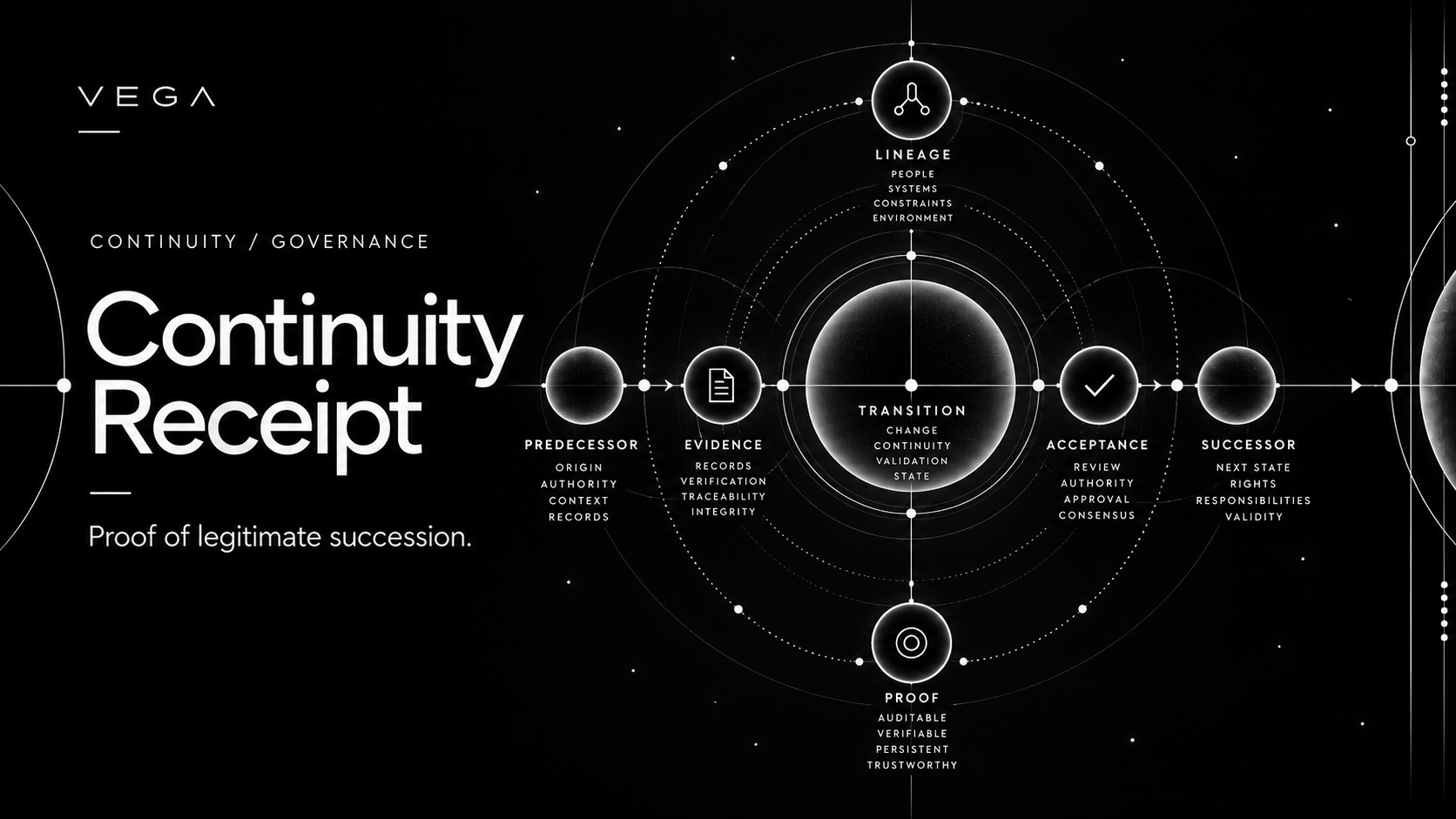
Every accepted transition should be capable of producing a compact Continuity Receipt.
The receipt is the portable proof of succession.
Example:
continuity_receipt:
  id: CR-0042

  predecessor:
    id: STATE-0041

  successor:
    id: STATE-0042

  transition:
    id: TRANSITION-0042
    intent: update governing identity definition

  authority:
    actor: authorised-owner
    source: current-direct-instruction
    scope: identity-definition

  invariants:
    preserved:
      - entity_identity
      - ownership
      - authority_boundary
    violated: []

  effects:
    expected:
      - governing definition updated
    observed:
      - governing definition updated

  evidence:
    - source_record
    - content_digest
    - acceptance_record

  acceptance:
    status: accepted
    accepted_at: 2026-09-22T18:00:00+09:30

  continuity:
    status: valid
The receipt does not need to contain the entire state.
It needs to contain enough information to establish the legitimacy of the transition.
14. Failure conditions
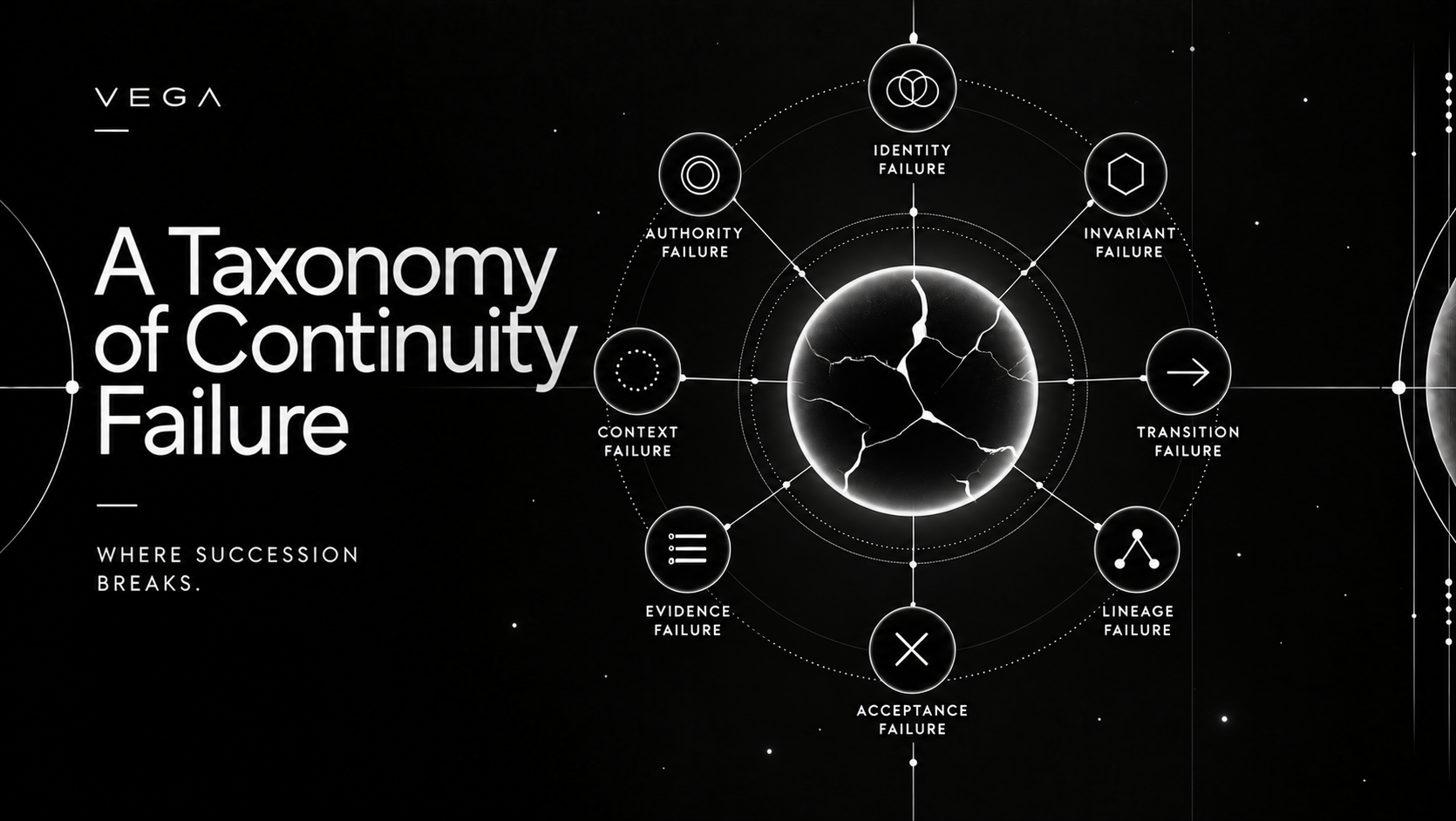
The model makes continuity failures explicit.
Orphan state
A successor has no valid predecessor.
? → S
Authority break
A transition occurred without sufficient authority.
P → T(unauthorised) → S
Invariant break
A required continuity condition was violated.
P → T → S
      × invariant
Intent-effect divergence
The transition intended one result but produced another.
intended(T) ≠ observed(F)
Evidence gap
A claimed effect lacks sufficient support.
claim(F) → insufficient E
Acceptance gap
A candidate state exists but has never been legitimately accepted.
P → candidate S
      no C
Conflicting succession
Two incompatible successors claim continuity from the same predecessor within the same exclusive scope.
       → S₁
P ─────
       → S₂
Stale succession
A previously valid state continues to be treated as governing after it has been superseded or revoked.
Lineage break
The current state cannot reconstruct the chain of legitimate transitions that produced it.
Each of these failures requires a different remedy.
Calling all of them “memory problems” destroys useful information.
15. Continuity state
The model distinguishes system state from continuity state.
System state answers:
What is true now?
Continuity state answers:
Why is this the accepted truth now?
A minimal continuity state therefore contains:
current accepted state
current governing authority
applicable invariants
predecessor reference
last accepted transition
supporting evidence
acceptance status
This allows a system to answer not merely what it is doing, but why its current condition legitimately follows from what came before.
16. Scope
Continuity is always evaluated within a scope.
A single entity may participate in multiple overlapping continuity chains.
For example:
identity continuity
authority continuity
operational continuity
knowledge continuity
relational continuity
institutional continuity
A transition may preserve continuity in one scope while breaking it in another.
A software migration may preserve operational behaviour while breaking audit lineage.
A leadership transition may preserve institutional identity while replacing operational authority.
A model update may preserve service identity while changing internal implementation completely.
For this reason, continuity should never be expressed simply as:
continuous: true
A stronger representation is:
continuity:
  scope: institutional-authority
  status: valid
Continuity is contextual.
Its claims must say what is continuous with what, and in what respect.
17. Genesis
Every continuity chain requires an origin.
The first accepted state is the genesis state.
Genesis cannot derive legitimacy from a predecessor because none exists.
Its legitimacy must instead come from an explicit act of constitution, creation or recognition.
A genesis record should therefore establish:
identity
initial state
initial authority
initial invariants
scope
constituting evidence
acceptance
Once established, the genesis state becomes the predecessor for subsequent transitions.
Continuity then proceeds through succession rather than repeated re-foundation.
18. Supersession
Continuity does not require old states to disappear.
It requires their status to be clear.
When a successor becomes accepted, the predecessor remains historically valid but ceases to govern within the superseded scope.
This distinction is essential:
historically valid ≠ currently authoritative
The continuity chain therefore preserves history without confusing history with current authority.
A superseded decision may remain perfectly accurate as a record of what once governed.
It simply no longer governs now.
19. Minimal runtime behaviour
A system implementing the Continuity Model needs only a small number of fundamental operations:
OBSERVE
Determine predecessor and current conditions.

RESOLVE
Determine governing authority, scope and invariants.

PROPOSE
Describe the intended transition and candidate successor.

ACT
Execute the authorised transition.

PROVE
Observe effects and collect evidence.

ACCEPT
Determine whether the successor becomes governing state.

LINK
Record predecessor → transition → successor lineage.
In compact form:
observe → resolve → transition → prove → accept
The result is not merely a changed system.
It is a changed system whose relationship to its previous state remains intelligible.
20. The continuity rule
The model can ultimately be reduced to one rule:
No successor becomes governing state unless its succession from the accepted predecessor can be justified through authority, invariants, effects, evidence and acceptance.
That rule is simple.
Its consequences are not.
It means state cannot silently become authority.
Memory cannot silently become truth.
Execution cannot silently become success.
History cannot silently become governance.
A proposal cannot silently become a decision.
A candidate successor cannot silently become the system.
Every governing state must earn its place in the continuity chain.
That is the function of the Continuity Model.
Continuity is legitimate succession across change.